Rockets generate energy knowledge from series of solar power lessons
April 22, 2026
Northeast High School students charged up their energy knowledge this spring by learning how solar electricity affects all of the Rockets.
Members of the Environmental Studies class spent three days examining details about the school’s new solar panels. Northeast science teacher Kristi Puls and John Hay of Nebraska Extension of Lancaster County led activities that showcased how sunlight is converted into electricity. Students toured the solar panel field, learned about energy distribution and consumption and calculated how many solar panels would power the entire campus.
Northeast senior Kwame joined his classmates for the indoor and outdoor activities. He said it was fun to discover more information about solar energy.
“I’ve learned a lot about how electricity is generated,” Kwame said. “It’s been really good.”


Hay said he enjoyed sharing his knowledge with the Rockets during the sustainability unit. He informs many residents about energy topics through his Nebraska Extension work. He also teaches an Energy Systems and Sustainability course to University of Nebraska-Lincoln students.
“I do think energy literacy is important, and it’s a building process for them,” Hay said. “They might not be purchasing their own electricity yet, but they will in a short number of years. As they drive vehicles, they’re going to be buying fuel. I think understanding energy terminology and how energy works is going to be essential for them.”
Puls said she was excited to watch students become engaged with the material. They learned about key electrical terms such as generation, transmission, distribution and load, and they found out that having a mix of energy sources helps power become more reliable. They also realized how vital the subject is in an age of 24/7 electrical consumption.
“I could see some of them really connecting with what was going on,” Puls said. “That was good to see.”


Puls said it is valuable for students like Kwame to learn more about new energy technologies. Data from the National Renewable Energy Laboratory (NREL) ranks Nebraska 13th in the nation in terms of the greatest energy potential from solar power. More than three dozen Nebraska counties or cities have constructed solar facilities that generate at least 950 kilowatts of power.
Lincoln joined that list in 2016 when Lincoln Electric System built the Holdrege Solar Center. Located at Northwest 75th and West Holdrege streets, the facility includes 15,333 solar panels that generate five megawatts of solar energy. It produces enough energy to power 900 typical homes in Lincoln.
The Rockets began their project by inspecting a series of new solar panels located next to Northeast’s tennis courts. Lincoln Public Schools installed its first solar arrays at Standing Bear and Northwest high schools in 2023. LPS expanded its solar capacity by adding Northeast’s panels in 2025. The school district also placed panels at Scott and Lux middle schools the same year.
LPS Sustainability Coordinator Brittney Wees said the solar panels have helped students in many ways. All five LPS solar arrays are located on the ground next to their schools, which has made them more accessible for educational lessons like those at Northeast.
“It is really great to see opportunities for students to connect with renewable energy generation expand across the district,” Wees said. “One of the benefits of having our arrays be ground-mounted instead of roof-mounted is the ability to have these classroom activities for students to get hands-on experience with them.”

Hay first gave students background information about the mechanics of solar generation and distribution. The class then looked at how the panels are slanted to best capture the sun’s rays in different seasons of the year. They also learned about live dashboards that provide real-time updates on how much daily energy the solar panels produce.
“I think they have a better sense of how the solar panels turn that sunlight into electricity,” Hay said. “We started with that, and then we explored where that electricity goes.”
The Rockets spent their second day calculating how much land would be needed to power Northeast’s entire campus from solar energy. They determined LPS would need to fill six acres with solar panels to accomplish that goal.
“I think that was a good visual for them to think about,” Puls said. “We’d need six football fields to make it happen.”
The class played a board game called Microgrid Mastermind on day three. Several of Hay’s college students created the game to show players how grids move electricity from power plants to home outlets. The Rockets bought fuel distribution lines, expanded electrical substations and determined which power sources would work best for their city.
Puls said Microgrid Mastermind showed students why it is critical to have multiple ways of providing energy to the public. Players picked up action cards each round that introduced either positive or negative twists to the game’s storyline. The Rockets learned how natural events such as droughts, cold temperatures and severe weather can put stress on the power grid. They also discovered that squirrels are the top reason for power outages in Nebraska.


“I loved this game because they could see all different types of power, and they knew how they needed to make those connections,” Puls said. “I think with this game, they were able to put it all together.”
Hay said he hoped the activities gave students a better grasp of a topic that impacts everyone in Lincoln.
“Energy is something that we interact with all our lives, so it’s important to start learning about it as soon as we can,” Hay said. “It’s important to understand what energy we use and how we can save and be efficient with it. This is something they will use throughout their lives.”
Track daily electrical usage of the five LPS solar sites through this LPS Sustainability webpage.
Do you have a story idea? Share it with the LPS Communications Team by filling out this form!

Published: April 22, 2026, Updated: April 22, 2026
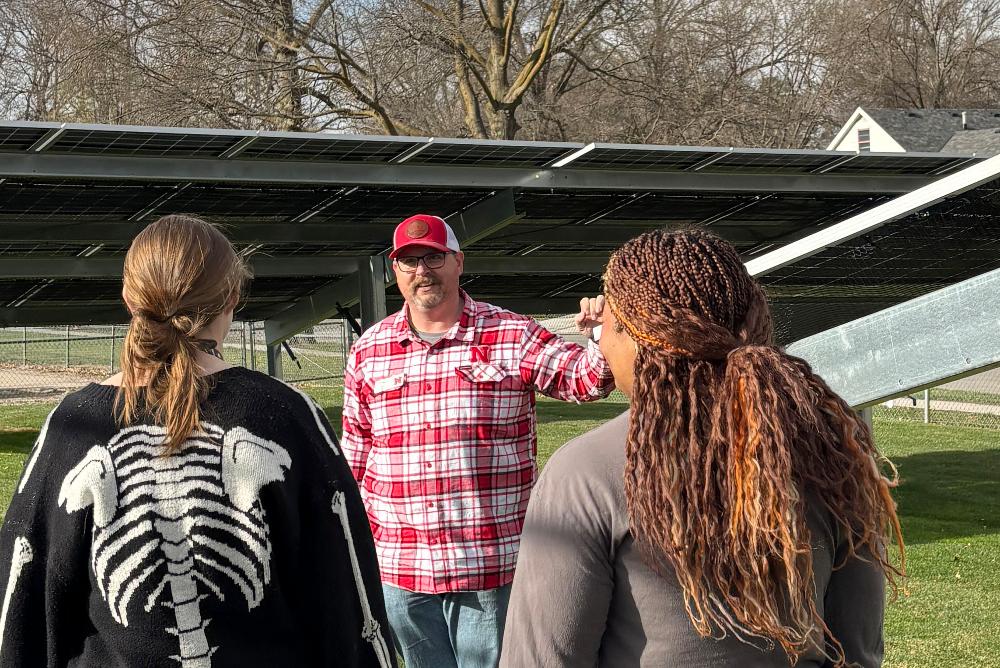
Nebraska Extension of Lancaster County employee John Hay smiles as he talks to two Northeast High School students this spring. Students in an Environmental Studies class examined the school's new solar panels that are located by the tennis courts. The outdoor activity was part of a three-day unit about solar electricity.
