LPS American Indian students learn about robotics at engaging workshop
April 29, 2026
Lincoln Public Schools students like Dean and ZenDaya learned how robots can strengthen both culture and community at an interactive workshop this spring.
The LPS fifth graders joined more than 20 fellow American Indian students at a workshop hosted by youth robotics inventor Danielle Boyer. She inspired them by incorporating themes of teamwork, friendship and entrepreneurship into a presentation about the benefits of technology. She helped them create plans for robots that could assist their elders with activities such as walking, gardening or picking things up.
ZenDaya, who attends Elliott Elementary School, designed a robot to help ease her grandmother’s grocery shopping. It included four baskets that provided space for her groceries and wallet. The machine also featured a bodyguard who would protect her grandmother while she was at the store.
ZenDaya said she would remember the workshop’s lessons in all of her LPS activities.
“It’s pushing me to my limit to learn how to be a respectful, safe and honorable student at Elliott,” ZenDaya said.


Dean, who attends Cavett Elementary School, displayed the same type of compassion as he sketched his robot at another table. He brainstormed a machine that could grab items for people from shelves with Spiderman-like webs. His spider bot also featured suction cups that would allow it to access hard-to-reach places with ease.
Dean said Boyer’s message of perseverance and triumph made him feel more confident in his ideas.
“Even though if people don’t believe you, you should always believe in yourself,” Dean said.
Joe Rousseau said those reactions are why he was excited to have students attend the workshop. Rousseau, the LPS American Indian education demonstration grant coordinator, received an e-mail this past fall from Dominique Ellis at the Center for Great Plains Studies. She told him about an opportunity to meet Boyer and learn about her groundbreaking work with American Indian languages and science, technology, engineering and math (STEM) topics.
“Danielle encouraged our youth to learn our languages, to follow our dreams as she did, to use our strengths towards improving our communities, and to empower ourselves with education so we have the tools needed to craft the future we want,” Rousseau said.
Boyer, who is Anishnaabe from the Sault Tribe, shared her story of growing up below the poverty line with her family. She did not have as many opportunities for science and technology classes as a youth, which has motivated her to make education accessible for everyone. She is the founder of The STEAM Connection, a youth-led charity that has reached hundreds of thousands of children across the world.
Boyer began her presentation by showcasing the positive effects of technology in villages and cities. She wanted to plant the seeds of high-tech interest for American Indian students and encourage them to consider the career field.
“I feel like tech is used in a lot of harmful ways, and I wanted to show ways that we can leverage it for good,” Boyer said. “I think that when we use technology for positive uses in our communities, it can create a lot of change.”
Boyer’s most recent invention is doing exactly that. She has created the SkoBot, which is an interactive American Indian language revitalization robot. Her grandmother is the last fluent speaker of Anishinaabemowin in her family, and Boyer wanted to ensure her heritage would be preserved for many future generations. The SkoBot is shaped in the form of a toy for kids. The device is also designed to bridge the gap between language learning and documentation in a family-based way.

Boyer said she was happy to watch students like ZenDaya and Dean come up with creative ideas during the morning. She felt they had the potential to turn their inventions into high-tech reality one day.
“I hope they’re excited by STEM,” Boyer said. “I think a lot of the time, it’s the first time people are being exposed to that, like what Indigenous tech could look like, and so I always hope that kids want to pursue that themselves.”
Dean said he was impressed by how the workshop introduced new ideas to him.
“It talked about how robots could help scientists and people,” Dean said. “So, I think I want to start building robots to help people.”

Rousseau felt the event also sparked an increased sense of belonging for everyone who attended.
“Students see for themselves they are not the only American Indian at their school, as we are in every classroom, in every school building,” Rousseau said. “We are still here.”
Rousseau said the opportunity for students to meet Boyer would have a long-lasting impact in academic, social and cultural ways.
“It is important for our students to see for themselves that LPS values our community and our understanding,” Rousseau said. “When LPS provides us with the space to celebrate our culture, the bridge is strengthened between our community and our schools, deepening the trust amongst our community for the public education our children receive.”
Learn more about American Indian educational opportunities at LPS.
Do you have a story idea? Share it with the LPS Communications Team by filling out this form!
Published: April 29, 2026, Updated: April 29, 2026
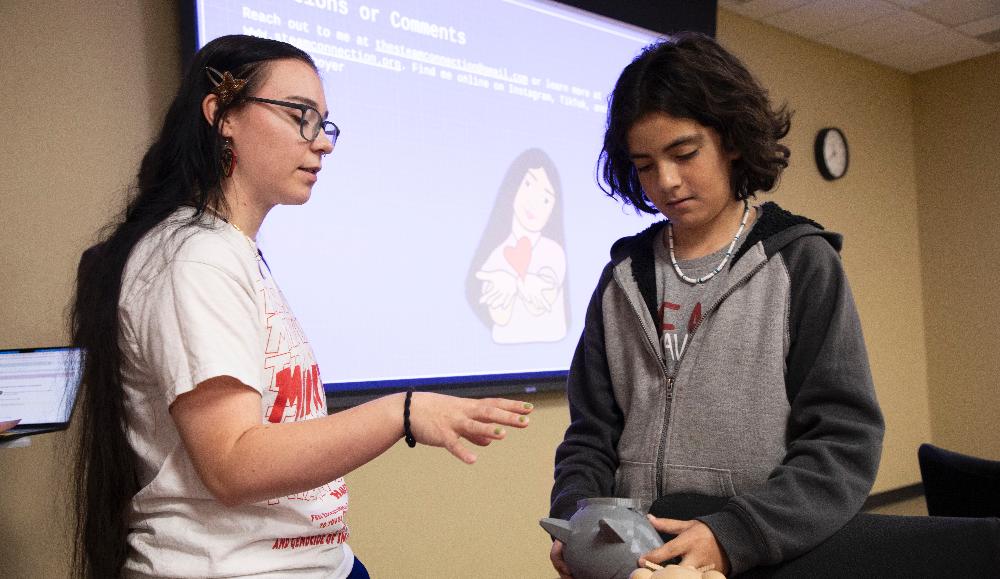
Danielle Boyer explains her SkoBot invention to a student at an American Indian robotics workshop this spring. Boyer created the SkoBot to help bridge the gap between language learning and documentation. She taught LPS students about the benefits of technology during the workshop.
